Fire in Flight – Page 4.
Simultaneously, out of the corner of my eye, I noticed a fire on the left wing and as I looked out I saw that the #1 engine was completely engulfed in flames. I said something like, "Number one's on fire and I'm shutting it down." The correct procedure is to have the copilot actually perform the steps as the AC calls them out, but I didn't want to waste any time, so I reached for the fire emergency control handle, pulled it, and moved the condition lever to the "feather" position. This streamlines the prop so that it won't windmill and cause drag. I called for the #1 fire bottle and Britt reached up and fired the first fire bottle. As he did that, I turned to observe the effect on the #1 engine. The fire went from engulfing the engine to just coming out of the outlets and louvers in the cowl. It was still burning pretty severely, so I called for the second fire bottle. When Britt fired it, the engine fire went completely out.
Here's were things started to get dicey. Extinguishing the engine fire revealed the potentially fatal fire beyond, and no amount of fire extinguisher was going to get this one out. There was a raging fire out on the wing, outboard of the #1 engine and obviously burning into the fuel tank. The full weight of the reality that this airplane was critically damaged flowed into my consciousness. It was like a sucker punch to the gut, that sick feeling you get when you realize perhaps you are not going to survive this one. One minute you think you have things under control, you are confident you are going to be able to work yourself out of the problem, then, all of sudden, you are no longer in control. The events have taken over as you become painfully aware of the responsibility you have to get these crew members safely on the ground--but failure seems imminent.
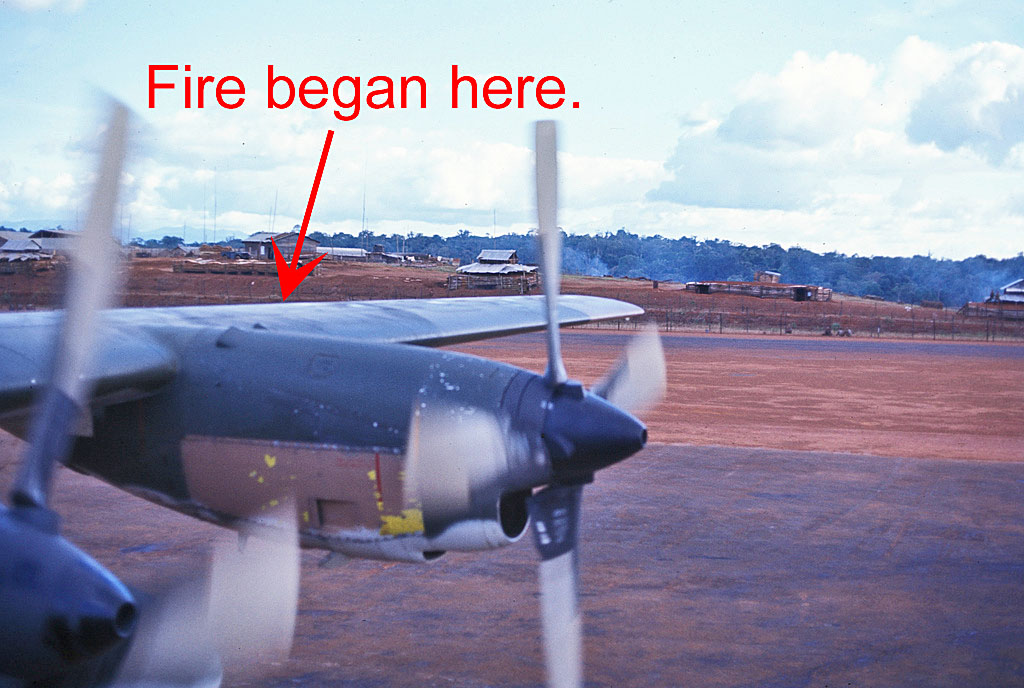
View from the pilot's seat out over the left wing on a C-130.
The photo on the left illustrates the pilot's view of the left wing. The arrow indicates the location of the wing fire when I first saw it just outboard of the number 1 engine.
My immediate thought was the wing was either going to blow or parts would start to burn off and render the aircraft uncontrollable. Thankfully, the rest of the cockpit crew could not see what I was seeing. If they had been able to, it would have been extremely distracting to say the least. The fire was burning starting at the wing trailing edge near where the aileron and flaps intersect, being fed by a 200-mph blast of oncoming air, and it was cutting through the wing like a giant blowtorch. You can get an idea of what I was seeing from the photo below.

Fig. 5 - View of the left wing fire from below.
Here you can see the condition of the left wing as we approached Tay Ninh with the #1 engine feathered. If you look at the wing trailing edge, you will note that parts of the flaps and aileron are gone. The aileron starts about halfway between the outboard engine and the wing tip. The flap extends all the way from the fuselage to the aileron. So about half of the aileron and about a third of the flap are missing. Notice the finger of flame that extends forward toward the leading edge. This was the blowtorch that I was looking at from the cockpit out over the top of the wing. As we were approaching Tay Ninh, it looked to me like this blowtorch had cut through the trailing edge spar and was approaching the main spar. You can look at this photo and visualize what the lift on this outboard section of wing was doing to the remaining wing structure. As I have said, it looked like the entire outboard section was bending up and twisting such that the trailing edge was moving up, which was changing the aerodynamics of the wing. The only person on the crew that had a good view of the fire from the bottom of the wing was the loadmaster, Jerry Willard.
June 16th, 2026 - 08:08
Hi Pat. It’s Tim Brady. You and I were in the 50th together at CCK. I talked to Gary Jackson the other day and he told me about your posting. Gary and I were classmates at Reese in 67E. I remember very clearly your adventure and appreciate the fine airmanship you and crew displayed in bringing that stricken airplane safely down. I too upgraded to AC under Col Balch but not as quickly as you. I think I read that you live somewhere in Florida as do I (In Ormond Beach). If so, let’s get together for drink, lunch, whatever.